U.S. Supreme Court Orders Louisiana Redistricting, Narrows Voting Rights Act Standard
Lisa Valadez | 4/29/2026, 3:53 p.m.
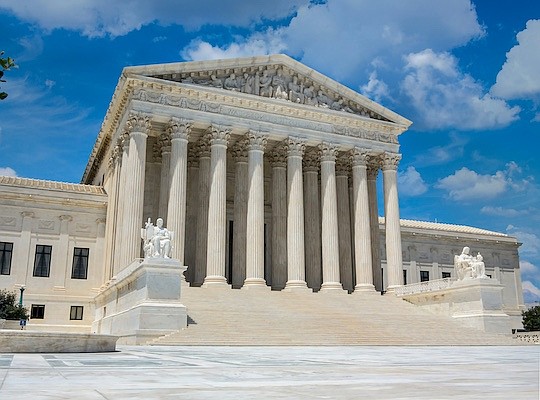
The U.S. Supreme Court on Wednesday ruled 6–3 that Louisiana must redraw its congressional map, while also tightening the legal standard used to evaluate claims of racial discrimination in redistricting under Section 2 of the Voting Rights Act.
The decision stems from Louisiana v. Callais, a dispute over whether the state’s congressional districts unlawfully diluted the voting strength of Black residents. While the Court left intact lower court rulings requiring Louisiana to revise its map, it significantly restricted how Section 2 can be applied in redistricting cases moving forward.
Section 2 of the Voting Rights Act of 1965 has long served as the primary federal tool used to challenge electoral maps and voting practices alleged to discriminate on the basis of race. In redistricting cases, it has been used to argue that district lines dilute minority voting strength by splitting or dispersing communities of color. Courts have at times required states to consider racial demographics when drawing district boundaries to ensure fair representation.
In its ruling, the Court did not strike down Section 2, but it raised the evidentiary burden required for plaintiffs to prove that a redistricting plan unlawfully dilutes minority voting power. The majority emphasized limits on the use of race as a factor in drawing districts and narrowed the circumstances under which Section 2 can be used to mandate race-conscious districting remedies.
As a result, states retain greater discretion in drawing congressional maps, even when challengers argue that district lines reduce the electoral influence of minority voters. However, the Court’s decision leaves in place the requirement that Louisiana redraw its current map, after lower courts found that the existing districts likely violated Section 2.
The Voting Rights Act of 1965 was enacted to prohibit racial discrimination in voting nationwide following the civil rights movement. It was designed to enforce the constitutional right to vote and address discriminatory practices that had historically limited political participation by Black Americans and other minority groups.
In practical terms, the ruling makes it more difficult to bring successful Section 2 challenges in redistricting cases, increases the burden of proof for plaintiffs, and is expected to influence how states approach congressional map-drawing ahead of future election cycles.
Civil rights advocates argue the decision weakens protections against racial vote dilution, while supporters of the ruling say it appropriately limits the role of race in government decision-making and restores greater discretion to states.
In dissent, Justice Elena Kagan, joined by the Court’s two other liberal justices, warned that the majority’s reasoning would weaken long-standing voting rights protections and make it easier for states to dilute minority voting strength through districting decisions.
The ruling continues a broader trend in which the Supreme Court, under Chief Justice John Roberts, has narrowed the scope of federal voting rights enforcement in redistricting cases. The decision is expected to prompt new litigation and legislative scrutiny as states prepare for upcoming redistricting cycles.