US embassies in the Middle East prepare for extended period with reduced staff amid Iran war
Jennifer Hansler, CNN | 8/12/2026, 11:19 a.m.
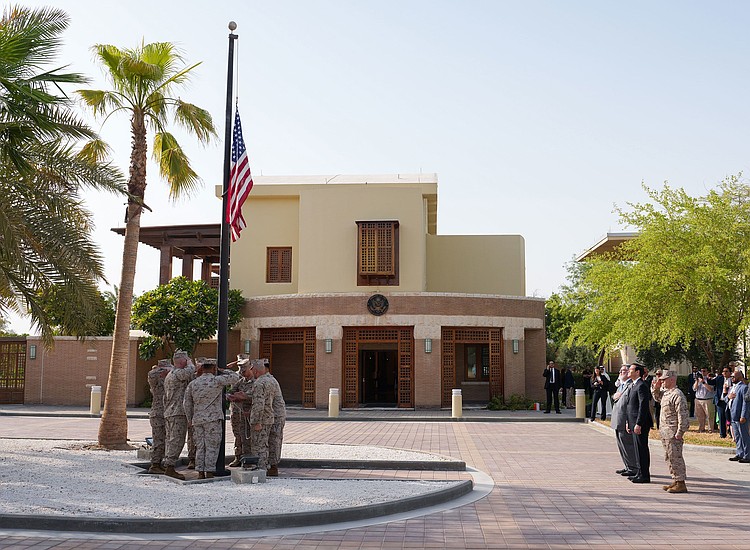
US Embassy Kuwait
Eric Lee/Pool/AP/File via CNN Newsource
The State Department is asking US embassies in the Middle East to create plans to continue operating with a small number of staff on the ground, sources told CNN, as the war with Iran shows no signs of resolution.
Additionally, personnel who have been displaced from their posts in the Middle East are increasingly being given the option to curtail their assignments, the sources said.
The plans have not been finalized, the sources said, and it is unclear if they will be implemented at all of the embassies that are currently on reduced staffing. Still, the developments underscore that the State Department does not expect to return to normal staffing in the region soon amid the looming threat of a full-scale return to war.
A State Department spokesperson told CNN that they “do not discuss internal deliberations or post-specific contingency planning,” but noted that the department “continually reviews the security and staffing posture at every diplomatic mission based on conditions on the ground and adjusts personnel levels as appropriate.”
“The safety and security of our personnel and their families remains the Department’s top priority as we continue to assess conditions across the region,” the spokesperson said. “Decisions regarding the status of any post are made based on a range of security and operational factors, in close coordination between posts and Washington.”
“Personnel matters, including individual curtailment requests, are handled on a case-by-case basis,” they added.
The State Department ordered nonemergency personnel and family members to leave almost every diplomatic post in the region shortly after the war began in late February. That has led to nearly six months of uncertainty about whether the posts would be able to return to normal and all diplomats could return. The plans for “reduced operations,” once finalized, could provide some clarity to US diplomats and their families who have been displaced.
Meanwhile, efforts to bring the war to an end have faltered. The memorandum of understanding between the two sides has collapsed. There was more than a week of back-and-forth strikes at the end of July. A renewed push for an agreement to fully reopen the Strait of Hormuz has yet to succeed.
The State Department did not reduce staffing at most of its embassies in the region before the US and Israel began their military campaign. Ahead of the war, only Lebanon and Israel were in ordered and authorized departure status, respectively.
Authorized departure means nonemergency personnel and family members could choose to leave but were not required to.
Within weeks, as US diplomatic facilities across the region came under attack by Iran and its proxies, the department ordered nonemergency personnel and families to leave Bahrain, Iraq, Jordan, Qatar, Saudi Arabia and the United Arab Emirates. The US Embassy in Kuwait suspended operations entirely in March and only resumed emergency operations for Americans in late June. It remains under ordered departure. The US Embassy in Oman is under authorized departure.
The sudden drawdown in staffing left diplomats and family members, many of whom had years left on their assignments, scrambling to find housing and to enroll their children in school back in the US. However, because it was unclear how long embassies would operate with reduced staffing, families couldn’t make longer-term commitments when they returned home. If normal operations resumed, they would be expected to quickly return to the Middle East.
One diplomatic spouse said their family has been “hopping around to different housing situations this whole time,” because they couldn’t risk the potential financial repercussions of signing a long-term lease and breaking it.
“We’ve had evacuations in various parts of the world, but this is different in that there’s such a large portion of people from one part of the world with so many people coming back to one spot,” they added.
Those who were forced to leave the region left behind almost all of their belongings, as well as support networks of friends who can be critical to an overseas posting.
The diplomatic spouse told CNN they feel “a tremendous sadness” for “the people we care about and the work that we’re part of” in the region.
“We had no idea when we walked out of our house in March that we not only wouldn’t be returning in six months, but now the reality is, we won’t be returning at all,” they said, requesting anonymity due to concerns of retaliation.
Under State Department rules, diplomatic posts cannot have their “ordered departure” status extended for more than 180 days. Once that limit is reached, if they are unable to return to normal status, they switch to “restricted operations,” which includes caps on in-country staffing. The State Department’s foreign affairs manual notes that restricted status “is intended as a temporary measure to address safety and security,” but “it may continue as long as necessary to ensure that adequate safety and security measures are in place.”
For the posts in the Middle East, restricted operations status will likely mean no children and few spouses will be allowed to return, sources said.
The State Department spokesperson said the department remains “committed to supporting our workforce and their families throughout this process and will provide updates through appropriate channels as decisions are made.”
It will also mean a continued shortage of US diplomats on the ground. For those who are still not able to return to their posts, they may try to curtail, but it is not clear whether there are enough alternate jobs for them.
And fewer diplomats on the ground could impact the State Department’s ability to provide quick consular assistance to Americans abroad and to advance the administration’s priorities, former diplomats said.
“When you have fewer people, there’s less you can do, and there’s a lot that you cannot do remotely,” said John Bass, a former career diplomat who served as an under secretary of state for management.
“The fewer diplomats you have in country, the fewer people you have who are focused on what is happening in that country, in that government, keeping tabs on key issues for the United States,” he explained. “You’ve got fewer people there to be promoting the US government’s views on what is happening and why, and what is in our interests and the interests of that country, working together, to try to solve a common problem.”
He noted that leaders might discuss a broad agreement on a matter, but it comes down to the experienced diplomats on the ground “to be able to really get into the details with that host government about how to move forward.”
Bass, who was an ambassador to Turkey, Georgia and Afghanistan, told CNN that the restricted operations status could potentially last “for months, if not years.”
The State Department spokesperson disputed the idea that diplomatic efforts by the US have been “limited” by having fewer people on the ground.
“We have seen sustained engagement from the highest levels of the Trump Administration with our partners in the Middle East, and our relationship with our allies in the region continues to get stronger,” they said.