Trump US attorney pick can no longer investigate one of the president’s top foes, court rules
Kara Scannell, CNN | 8/21/2026, 2:44 p.m.
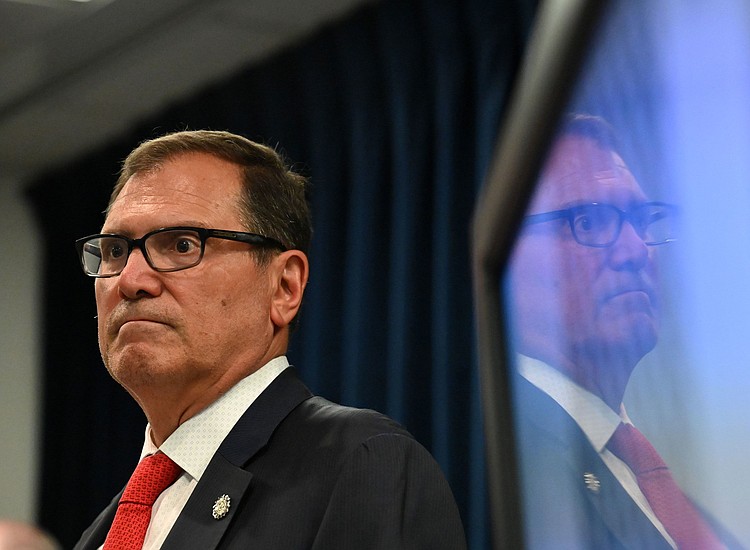
John Sarcone
Will Waldron/Albany Times Union/Getty Images via CNN Newsource
A divided federal appeals court ruled that the Trump-picked US Attorney in Albany is serving unlawfully and can no longer be involved in the investigation of one of the president’s top foes.
The Second Circuit Court of Appeals, in a 2-1 decision, upheld a lower court’s ruling from January that said the appointment of John Sarcone, then-Acting US attorney for the Northern District of New York, is not valid and disqualified him from a probe into the state’s Attorney General Letitia James.
The decision marks the third time a federal appeals court has rejected as unlawful the Trump administration’s process for naming US attorneys without Senate approval.
“We disagree with the court’s decision, and intend to take this case to the Supreme Court,” the Justice Department wrote in a tweet Friday.
Earlier this week, the Ninth Circuit Court of Appeals said the US attorney for Nevada, Sigal Chattah, is serving unlawfully. The Justice Department said it would appeal to the Supreme Court. In December the Third Circuit ruled that Alina Habba was not validly appointed US attorney for New Jersey.
Next month, the Fourth Circuit will hear arguments over whether a lower court’s finding that the appointment of former Trump lawyer Lindsey Halligan as US attorney for the Eastern District of Virginia was unlawful.
The impact of those decisions has varied. In the cases where the US attorney acted alone, the underlying indictment or subpoenas were dismissed — such as the subpoena and separate indictment of New York Attorney General James and the perjury indictment of former FBI Director James Comey.
In other decisions where the US attorneys’ status was successfully challenged, the indictments were not dismissed because other legally serving assistant US attorneys were involved in the underlying cases.
Sarcone continues to serve as First Assistant US attorney and held a press conference on Thursday to announce a criminal complaint charging a woman in an ISIS-inspired terror plot to blow up the capitol building in Albany, New York. Chattah is still leading the Nevada office as First Assistant US attorney.
Pressure by judges in Virginia led to the resignation of Halligan, who had presented Comey’s first indictment to a grand jury. In New Jersey DOJ abandoned the three-person team named to replace Habba, who had already resigned, after a judge ordered sworn testimony about its structure. The chief judge in New Jersey ultimately named the next US attorney in consultation with DOJ.
The Justice Department has vigorously defended its appointments and the process they have used — naming their lawyers as first assistants or special attorneys and then delegating them authority to serve as acting US attorneys.
The majority opinion, which rejected DOJ’s argument, was issued by Judge Maria Araujo Kahn, who was nominated by President Joe Biden, and Judge Guido Calabresi, who was nominated by President Bill Clinton.
They found that the Federal Vacancies Reform Act says only the First Assistant in the position at the time the US attorney’s post becomes vacant can step into the role — not someone the administration places into the position to bypass the Senate confirmation process.
“Designating a First Assistant after the vacancy is not automatic succession at all; it is a deliberate and discretionary choice made without any of the criteria Congress enacted,” they wrote.
“The Government’s reading thus rewards evasion and penalizes compliance—a strange design for a statute Congress enacted to stop the Executive from skirting the Vacancies Act,” the majority wrote.
It noted that the government has conceded that Sarcone can no longer serve as Acting US attorney because his tenure has exceeded the 210-day limit.
“As of this decision, the President has not submitted a nominee to the Senate and, according to the Government, Sarcone continues to serve as the operative head of the U.S. Attorney’s office,” it said.
In Friday’s decision, a Trump-appointed judge on the Second Circuit, Michael Park, dissented from the majority and agreed with DOJ’s process.
“The better reading of the statute is that any first assistant to a vacant office becomes acting officer, subject only to the time limits in § 3346,” Park wrote. Under section 3346 of the Federal Vacancies Act an acting officer can serve for 210 days.
“And the majority’s arguments based on statutory structure are actually policy arguments that overlook Congress’s understanding that the executive branch must function during periods of transition and political stalemate,” he added.