When Words and Actions Don't Align: Reflections on Black Media, Campaign Outreach, and Respect
Lisa Valadez | 7/20/2026, 5:26 p.m.
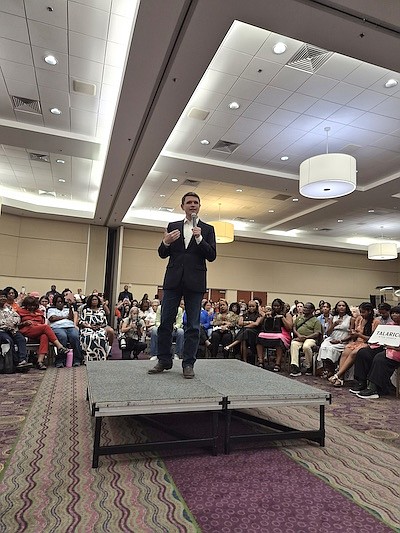
James Talarico Townhall - Houston, TX
For almost four decades, Houston Style Magazine has been rooted in the communities we serve. We have never viewed journalism as simply reporting the news. We believe in showing up, building relationships, and earning trust long before the headlines appear.
Our publisher, who continues the legacy established by his father, has spent decades cultivating relationships across Greater Houston. Those relationships extend to elected officials, nonprofit leaders, business executives, faith leaders, educators, and residents from every corner of our community. We are often called upon not because we are a large media outlet, but because we are accessible, trusted, and deeply connected.
Our mission has always been to ensure that important information reaches communities that are too often overlooked. That means telling stories others may miss, highlighting issues that matter to our readers, and serving as a bridge between public officials and the people they represent. Community building is not a marketing slogan for us. It is part of our DNA.
That is why Houston Style Magazine has never operated like traditional media. We do not chase every headline. Sometimes the biggest story is not what dominates cable news, but what directly impacts families, neighborhoods, and communities that deserve to be informed.
With that perspective, one concern has become increasingly apparent during State Rep. James Talarico's campaign. There has been limited outreach to Black media and Black community institutions in Houston.
This observation is not intended as criticism of Talarico personally. Campaigns are often managed by staff, and staff members frequently serve as gatekeepers. That is understandable. However, when a campaign acknowledges it is struggling to connect with Black voters or other historically underserved communities, it would seem logical to engage local Black-owned media outlets, local Black communications professionals, and trusted community leaders who have spent years cultivating those relationships.
Representation matters within campaign operations just as much as it does in elected office. When the people making outreach decisions do not reflect, or fully understand, the communities they hope to engage, communication gaps inevitably develop. Houston is not Dallas, Austin, San Antonio, or rural Texas. Every community has its own trusted voices, institutions, and media ecosystem. Those distinctions matter.
Black media has historically been overlooked despite its proven ability to reach audiences that traditional outlets often cannot. That reality continues today.
Yesterday's town hall was presented as an opportunity for Black Houstonians to share concerns, ask questions, and engage directly with Talarico. While attendees represented many racial and ethnic backgrounds, Black voices remained at the center of the discussion.
Whether attendees felt every question was fully answered depended on whom you asked. Some left satisfied. Others wanted more. What many agreed upon, however, was that Talarico deserved credit for listening and for engaging in difficult conversations.
Some media outlets characterized the atmosphere as "hostile." That was not how many Black attendees described it. The people I spoke with instead used words like passionate, concerned, engaged, and invested. They were asking difficult questions because they care deeply about the future of Texas.
During the town hall, Talarico acknowledged that he cannot win Texas without Black voters. He also spoke about the importance of working with Black media.
That statement caught my attention.
Since the beginning of his campaign, Houston Style Magazine has attempted to help the Talarico campaign identify trusted Black and Hispanic-owned independent media outlets across Houston and throughout Texas. We shared contacts for Black-owned media organizations, local Black-owned public relations firms, and other community resources capable of helping the campaign reach audiences that are often difficult to reach through traditional media.
Those conversations took place with campaign staff, not directly with Talarico.
More recently, one staff member contacted me seeking assistance in connecting with Black community leaders and Black and Hispanic media organizations in Houston. I was happy to help because, first and foremost, I am a voter who believes meaningful engagement with every community matters.
Before the town hall began, I entered a classroom-like meeting space where numerous elected officials, candidates, and longtime community leaders had gathered. These were individuals with whom Houston Style has built relationships over many years. We discussed upcoming stories, future meetings, campaign coverage, and community initiatives. One elected official even thanked us for consistently helping share important information with the public.
I also began taking photographs for what I intended to be a photo spread highlighting the many elected officials and community leaders who had come to support Talarico.
Nothing about the room suggested it was a private gathering. There was no signage indicating restricted access, no staff member checking invitations at the door, and no activity inside that distinguished it from any other meeting room.
After stepping out briefly to photograph attendees arriving for the town hall, I returned to continue conversations with elected officials and community organizers. While I was speaking with one of them, the same staff member who had previously asked for my help connecting the campaign with Black leaders and Black media approached me, tapped me on the shoulder, and loudly said, "You know I love you, right? But I need you to leave."
At first, I thought he was joking. The look on my face must have reflected my confusion because he quickly explained that the gathering was invitation only and that members of the press were not permitted.
I complied and began walking toward the exit. As I made my way into the hallway, the staff member continued to follow me, explaining that he was simply doing his job.
To be clear, I understand that campaigns have every right to hold private meetings and limit media access. My concern was never that I was asked to leave. My concern was the manner in which it was handled.
Rather than quietly asking to speak with me privately, I was interrupted in the middle of a conversation and asked to leave within earshot of everyone around me. The interaction created the impression that I had intentionally entered a space where I did not belong, despite there being no indication that the room was restricted.
As we walked toward the main town hall, I told him there was a more respectful way to handle the situation. A simple request to step aside for a brief conversation would have accomplished the same objective without creating an awkward public moment.
As I reflected on the exchange, I could not help but think about the treatment of Black and Brown journalists that has played out nationally in recent years. It was surprising to experience something that felt dismissive at an event centered on engaging Black voters and strengthening relationships with Black media.
Had someone simply informed me that the room was reserved, I would have immediately understood and left without hesitation. There would have been no issue. Again,t he room appeared to be an ordinary gathering space. There was no signage, no check-in process, no private briefing underway, no refreshments, and no visible indication that the meeting was restricted in any way.
Word of the interaction spread. Before the town hall began, a respected Houston communications specialist approached me asking what had happened. After I explained the situation, the specialist found the staff member and expressed that Houston Style Magazine should not have been treated that way, emphasizing that we have long been part of Houston's civic and political community.
Later that evening, I received multiple text messages from elected officials, organizers, and community leaders asking if I was alright.
I was.
Being asked to leave a private room was never the issue.
The issue was respect.
For decades, Houston Style Magazine has worked alongside elected officials, campaigns, nonprofits, businesses, and community organizations, not simply as media observers, but as trusted community partners committed to informing the public. We understand that there are times when the press cannot be present. We respect those boundaries.
What was difficult to reconcile was hearing, only moments later, Talarico speak passionately about the importance of Black media after an interaction that left one of the only Black media outlets present feeling excluded, feeling disrespected.
That raises questions worth asking.
Is the candidate aware of how his campaign is engaging with Black media? Does the campaign's outreach reflect the values he expressed publicly? Are trusted Black media organizations viewed as genuine partners in community engagement, or only as an audience to acknowledge from the stage?
Those questions are larger than one campaign.
They speak to a recurring challenge in politics. Campaigns often say they value Black communities and Black media, yet too often fail to engage the institutions that have spent decades earning the trust of those communities.
Houston Style Magazine will continue doing what it has always done, showing up, informing our readers, building relationships, and telling the stories that matter. That commitment has never depended on an invitation, and it never will.