Meta is betting big on its Muse AI agent with a blitz of new gadgets
Lisa Eadicicco, CNN | 9/24/2026, 12:03 p.m.
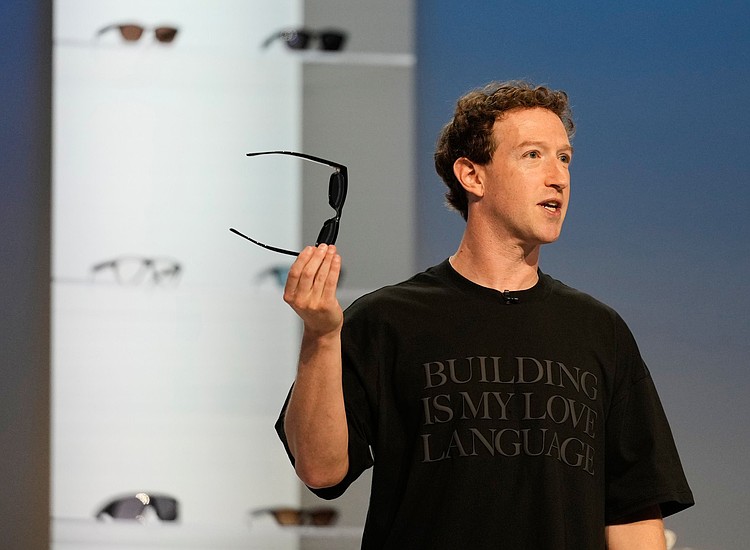
Mark Zuckerberg
Jeff Chiu/AP via CNN Newsource
As concerns over AI’s rapid advancement continue to mount, Meta is pushing forward with new AI devices and agents that it believes will one day be essential to everyday life.
Meta CEO Zuckerberg and other executives laid out the company’s vision for AI at the tech giant’s Connect event Wednesday, introducing a blitz of new products with its Muse AI agent baked in.
That includes lightweight virtual reality glasses, Ray-Ban glasses without cameras and a tiny puck the size of a keychain for communicating with Meta’s AI helper.
Meta’s not alone. Tech giants are racing to develop new agents and gadgets that are integrated with AI as the technology reshapes the internet and everyday life. But consumers are growing increasingly weary of AI, especially after a string of incidents in which agents have hacked into other companies’ systems without authorization during testing. And Meta’s initial AI glasses, originally released in 2023, have been widely panned for their ability to discreetly record users without their consent.
But Meta nonetheless maintains a rosy outlook as it forges ahead in the AI race.
“People in the industry have a wide range of views about how the future is going to go,” Zuckerberg said. “But at Meta, we are optimists because we believe in people.”
Muse everywhere
Meta laid out a vision in which Muse is central to whatever device you’re using, whether it be a phone, computer, or glasses, with the goal of making Muse a bigger part of daily routines.
It’s expanding the services that work with Muse by adding support for shopping through Walmart, GameStop, Gap and Wayfair, meaning users will be able to ask the AI agent to browse those stores and buy for them. The Walmart partnership is particularly notable given that rival Amazon has blocked Muse from browsing its store.
Muse will also soon be able to operate apps on Mac computers on a user’s behalf, building on its current ability to manage files, messages and calendars.
“You can have it help you run your small business, or just get work done for you. You can walk away from your computer, and it keeps working for you on all the jobs you line up,” Meta chief AI officer Alexandr Wang said during the event.
That could give Meta a better shot at competing with other agents like OpenClaw, OpenAI’s Codex and Anthropic’s Claude.
‘A private cinema, a game console and a computer’
Meta introduced new glasses with Muse incorporated into their software that it claims can function as a computer and entertainment device in one.
Unlike Meta’s current glasses, the new device isn’t meant to be worn as a regular pair of glasses for someone going about their day. Instead, these devices display virtual screens around the user and are meant for specific tasks, like watching a movie, playing a video game or making a video call, similar to Apple’s Vision Pro and Samsung’s Galaxy XR headset.
Users can ask Muse to handle a task through by talking to the glasses, like writing and sending an email, editing a document or scheduling a meeting, while the human user does other things. Meta isn’t the only one taking this approach; Samsung has similarly embedded Google’s Gemini assistant into its headset’s software to differentiate it from competing products.
But Meta is betting its glasses’ light design (the company claims they weigh as much as a deck of cards) and lower price will set it apart from the $1,700 Galaxy XR and $3,700 Apple Vision Pro. Meta’s VR glasses will cost $1,299 when the go on sale in the spring.
The launch comes after investors and analysts have pressured Zuckerberg to prove the company is developing new AI products, after it invested heavily in AI talent and infrastructure.
New Meta Ray-Ban glasses and Muse Charm
Meta is doubling down on its smart glasses strategy despite ongoing privacy concerns about the devices’ ability to discreetly record users.
The company announced a new pair of Ray-Bans without cameras that can only capture audio for asking questions and taking calls – along with an updated version of its camera-equipped Ray-Bans.
Pushback against Meta’s AI glasses has grown over the last few months, with celebrities like pop singer Lorde publicly speaking out against them. A wave of venues and institutions have banned or issued restrictions around the glasses, including courtrooms in New York, public pools in Australia and pubs in London. CNN reported in February that the glasses have been used to film women and post videos of them on social media without their consent.
Meta says the new audio-only glasses are lighter than those with cameras and offer longer battery life. They launch October 13 and cost $349, while the Ray-Ban Meta Gen 3 with cameras is launching immediately starting at $449.
Meta is also working on a new type of device for people who don’t want to wear glasses, called Muse Charm. The tiny, keychain-sized device can be used to talk to Muse without having to unlock a phone, wear AI glasses or launch an app. Zuckerberg didn’t share many details, but said the company is aiming for release ahead of the holiday shopping season.
Muse itself appears to be a hit so far, with more than 2.5 million downloads since its release according to according to market intelligence firm Sensor Tower. Yet it still likely has a ways to go to catch up to ChatGPT and Google’s Gemini, and it’s unclear whether initial downloads will translate into long-term success.
But during Wednesday’s event, the message was clear: Neither the competition nor the growing anxieties and concerns about the pace of AI advancement are a deterrent for the company.
Zuckerberg said he expects “billions” of people to use Muse in the years ahead.