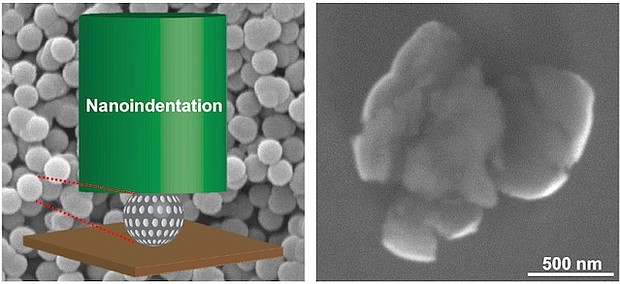
Rice University materials scientists synthesized spherical, porous nanoparticles of calcium and silicate, formed films and pellets and tested their toughness under pressure from a nanoindenter. They found films made of larger particles approaching 500 nanometers were much tougher and the films and pellets less prone to cracking under pressure. At right, small particles are deformed after nanoindentation. (Credit: Multiscale Materials Laboratory/Rice University)
Stories this photo appears in:
Particle Size Matters for Porous Building Blocks
Rice University scientists find porous nanoparticles get tougher under pressure, but not when assembled
Porous particles of calcium and silicate show potential as building blocks for a host of applications. A Rice University laboratory tested calcium-silicate particles to see how they hold up under pressure and found that size influenced the toughness of individual particles but not assemblies.