Who Will Be on the Ballot?
Fort Bend Commissioner Race Hinges on Court Ruling
Lisa Valadez | 4/15/2026, 4:53 p.m.
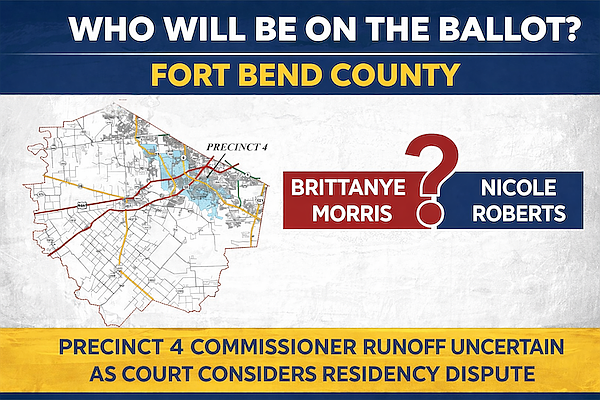
A legal battle over ballot eligibility in Fort Bend County’s Democratic primary runoff for Precinct 4 commissioner has escalated to the state’s highest court, leaving uncertainty over who will ultimately appear on the May 26 ballot.
Earlier this month, a district court judge ruled that candidate Brittanye Lashay Morris was ineligible to run for the office, citing failure to meet Texas residency requirements. In an order signed April 3, 434th District Judge Susan Brown directed the Fort Bend County Democratic Party to remove Morris from the runoff ballot and replace her with Nicole Roberts, who finished third in the March 3 primary election and filed the legal challenge.
The dispute centers on a state law requiring county commissioner candidates to reside continuously within the precinct for at least six months prior to the filing deadline. With a filing deadline of December 8, 2025, candidates were required to establish residency in Precinct 4 by June 8, 2025. Roberts argued that Morris did not meet that threshold.
Court filings and testimony highlighted several pieces of evidence related to Morris’ residency. Morris, a former judge of Harris County’s 333rd District Court whose term ended in December 2024, registered to vote in Fort Bend County on January 30, 2025, using a Richmond address. She later re-registered at a different Precinct 4 address on January 1, 2026, nearly a month after the filing deadline. Additional records cited by Roberts included a Houston P.O. box listed on Morris’ candidate application, a Texas driver’s license tied to a Houston address, and vehicle registration in Harris County.
Morris, who received the most votes in the March primary and advanced to the runoff alongside second-place finisher April Jones, disputed the ruling and signaled plans to continue fighting it. None of the seven Democratic candidates received more than 19% of the vote in the primary, triggering a runoff since no candidate surpassed the 50% threshold required for outright victory. Roberts’ lawsuit argued not only that Morris was ineligible, but also that the runoff should be recalculated without Morris’ votes, which would place Roberts in the second runoff position. Following the district court ruling, Morris filed a petition in intervention challenging both the court’s jurisdiction and Roberts’ legal standing to bring the case. The case took another turn when the Texas Supreme Court issued an emergency stay, effectively blocking the lower court’s order and allowing Morris to remain on the ballot for now. The stay grants temporary relief while the court considers whether to overturn the district court’s decision.
As the legal fight continues, candidates are still campaigning on the ground. Second-place finisher April Jones said her campaign remains focused on reaching voters despite the uncertainty surrounding the ballot. “Yes, Morris is still on the campaign, for now. We will see what happens in the next few days, weeks,” Jones said. “The candidates are on the ground doing the work, knocking on doors to reach voters. I do not have the same campaign funds and am working my best to reach the voters with mailers and knocking on as many doors as I can. I need volunteers. But I am still working with what I have.” Jones emphasized that her campaign is relying heavily on grassroots outreach, including direct voter contact, as the court process plays out.
Additional scrutiny has also emerged outside the courtroom. Reports circulating on social media, including commentary from reporter Miya Shay, referenced claims from individuals in Houston’s Upper Kirby area who said Morris resided there, while her campaign has stated she is renting a home in Fort Bend County. During court proceedings, however, attorneys for Roberts focused primarily on voter registration records rather than broader residency claims. Questions have also been raised about the rental property cited by Morris’ campaign, with observers noting that an alleged trust connected to the home and registered voters at that address share a last name with Morris’ campaign treasurer. While those alleged connections have not been central to the legal arguments presented in court, they have added to public scrutiny surrounding the case.
With the runoff election approaching, the Texas Supreme Court’s forthcoming decision is expected to determine whether Morris remains on the ballot or whether the lower court’s order to replace her with Roberts will be upheld.