Smoke Over Cahokia
A millennium ago, the greatest city north of what is now Mexico rose on the Mississippi. Then it emptied. Last week, smoke found it again.
Ben Jealous | 7/20/2026, 2:08 p.m.
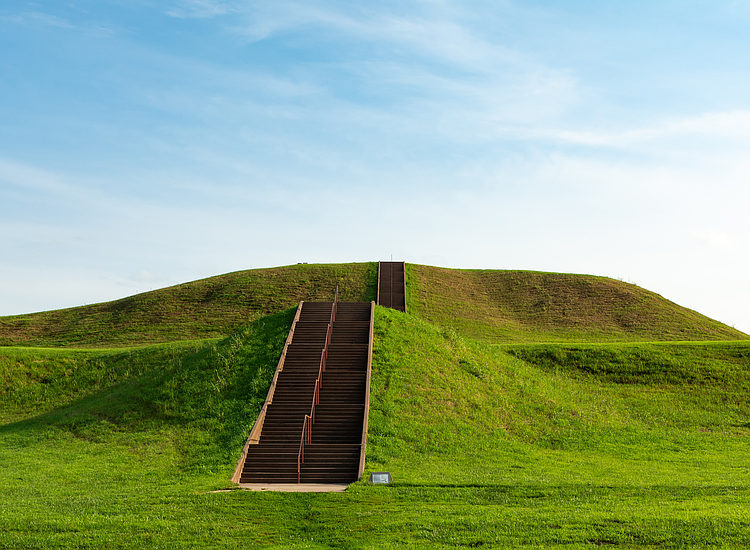
Cahokia Mounds State Historic Site, the largest prehistoric Native American city north of Mexico, on a sunny summer morning. Collinsville, Illinois, USA.
The smoke came down out of Canada last week. It turned the skies in Chicago and throughout the Midwest the color of dishwater. Then it kept coming south, until it drifted over a field across the river from St. Louis where the largest city north of what is now Mexico once stood.
Most of us were never taught it was there.
A thousand years ago, ten to twenty thousand people lived at Cahokia. They farmed corn on the bottomland, traded copper down from the Great Lakes and shell up from the Gulf and raised 120 mounds of packed earth one basket at a time, the largest a hundred feet high and fourteen acres at its base.
It was bigger than London. It was a city.
I have stood on top of them. You climb, and the ground keeps rising longer than you expect, and at the top the whole valley lies open underneath you, and eight miles west the St. Louis skyline stands up out of it. It is quiet up there. Grass and wind, and nothing at all to tell you what you are standing on. You have to be told. Then you look again, and the field is not a field anymore.
Cahokia rose in good years. Tree rings say it was founded during one of the wettest fifty-year stretches of the millennium, when the rain came on time and the bottomland gave back everything it was asked for.
Then the rains changed. Drought came after 1150. Around 1200, a flood big enough to swallow the farmland left its signature in the mud of a lake beside the city.
We can watch what happened next. They left it in the ground.
Around 1175, the Cahokians put a wall around the heart of their city, two miles of it, twenty thousand logs sunk in trenches five feet deep, with towers every eighty-five feet, the spacing a man needs to cover his neighbor with a bow.
They built that wall four times. Each time, they used fewer logs. There were fewer hands left to carry them.
Walls like it went up across the middle of the continent between 1200 and 1400. In a cemetery in the Illinois River valley, dating to about 1300, at least a third of the adults died violently. Scalped. Shot. Left where they fell. Farther up the Missouri, at a place called Crow Creek, a village dug a ditch and raised a wall to keep itself safe, and around 1325 at least 486 of its people were killed and buried in it, their bones showing they had been hungry long before anyone came.
That was not Cahokia. Different people, different place. And no honest scholar will tell you the drought pulled the trigger.
But that is what hunger and fear look like when they last long enough. Why Cahokia emptied is still argued. And the story I was taught turns out to be false. It said the Cahokians cut down too many trees and flooded themselves out. Archaeologists went looking for that flood and could not find it. It had never been tested. It was only believed, because it flattered us to believe it.
The likelier answer is harder. The climate changed first. Then the pressures came together. The harvests got thin. The politics got mean. The trust wore out. Some families left, then more, and by 1400 the plazas were empty and the grass had come back over them.
That is the order of it. Climate change starts in the sky and the soil. Then it moves through food, fear, power and faith.
Columbus did not reach the Caribbean until 1492. He never saw Cahokia.
Here is what those mounds say to me.
They say a people can build something so large a thousand years of weather cannot erase it.
They say the same people can be pressed until they wall themselves off from one another.
They say a people can walk away from all of it, and regather, and build again.
They say all three things. They are the same mounds. Cahokia’s people did not vanish. They walked. They regathered. They built again. Dr. Andrea Hunter, who keeps the history of the Osage Nation, will tell you her people trace their ancestry to that world and are still here, in Oklahoma.
That is the hope. It is not a promise.
Last week the smoke drifted over the city you can see from up there, and over the city you are standing on.
Two things are still in that ground. The mounds they raised together. The trenches they dug when the trust ran out.
We are building both right now.

Ben Jealous is a professor of practice at the University of Pennsylvania and former president and CEO of the NAACP.