The First Columbus Day Was Declared in the Shadow of a Lynching
In the Windy City, Frederick Douglass and Ida B. Wells spotlighted what Washington wanted forgotten.
Ben Jealous | 10/5/2026, 11:46 a.m.
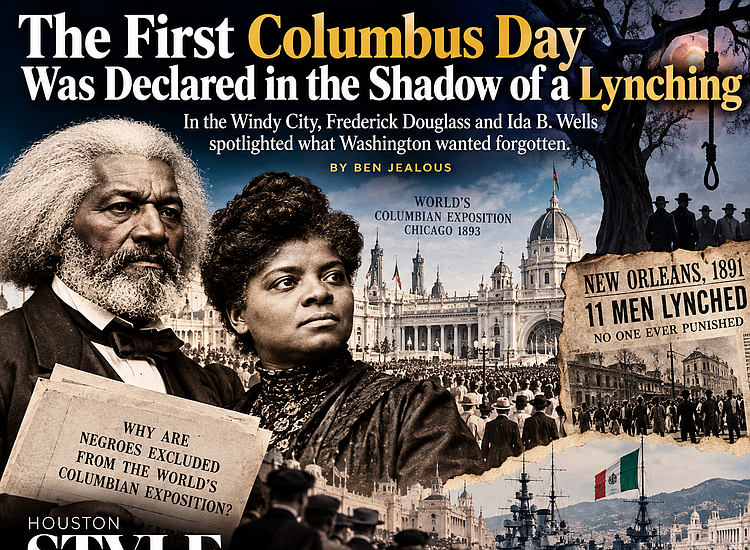
The First Columbus Day_ History Uncovered-Ben Jealous
This month we mark Columbus Day. The first one was a Chicago story.
In the fall of 1892, the nation celebrated four hundred years since Columbus reached the Americas. Chicago was its grandest stage. The city dedicated the grounds of the World's Columbian Exposition.
When the world arrived the next spring, Frederick Douglass was there. He was the most photographed American of his century. At seventy-five, he ran the Haitian Pavilion for the government of Haiti. Ida B. Wells worked beside him, putting a pamphlet into the hands of foreign visitors. She sent out 10,000 copies. When hecklers jeered one of his speeches, Douglass threw aside his notes and spoke right over them.
The pamphlet asked why African Americans had been shut out of the fair. Douglass wrote its opening as a wish list. Every item on it was something he could not honestly tell the world.
He wished he could say the national government "is not a rope of sand." A rope of sand looks strong. It holds nothing. He wished he could say it would send warships to punish "the murder of its citizens in New Orleans." It sent them fast enough to Chile and Haiti.
Everyone who received their message knew what had happened in New Orleans. Two years earlier, the city saw one of the largest mass lynchings in American history. The victims were Italians and Italian Americans.
On March 14, 1891, a lynch mob broke into the jail. It killed eleven men accused in the murder of the city's police chief. Three had just been found not guilty. Three had a trial end with no verdict. Five had never been tried. No one was ever punished for their murders.
Italy's top diplomat in Washington said only three or four of the dead were Italian citizens. The rest were Americans, or on their way to becoming Americans. Italy wanted the killers tried. It wanted payment for the victims' families. Secretary of State James G. Blaine said Washington could not promise a trial. Murder was Louisiana's business. Italy called its diplomat home.
President Benjamin Harrison admitted the problem to Congress. He asked Congress to let federal courts try crimes against foreigners. Congress did nothing.
So the government paid instead. In April 1892, the United States gave Italy 125,000 francs, about $25,000, for the victims' families. Blaine wrote that the President hoped the money would "efface all memory of the unhappy tragedy." In other words, forget it. Italy said the two nations were friends again.
 Ben Jealous
Three months later, Harrison proclaimed a national holiday for Columbus. That fall, Washington sent two warships to Genoa for Italy's own Columbus celebration.
The same government that could not protect eleven men in a New Orleans jail sent warships to honor Italy. The first Columbus Day was declared in the shadow of the lynching.
Italy had a king and a navy. The families of its citizens got paid. The families of the Italian Americans killed beside them got nothing.
When a lynch mob turned on this hated group of European immigrants, the world took notice. African Americans lived with that danger every day. In 1891 alone, the Chicago Tribune counted 169 African Americans killed by lynch mobs. Their families got nothing. No foreign power spoke for them. No warship sailed.
Congress waited 131 years to make lynching a federal crime. The Emmett Till Antilynching Act became law in 2022. Until then, the rope was sand.
The first Columbus Day asked Americans to look away from a lynch mob and toward a hero. In one sense, it worked. Italian Americans are safe today in ways their great-grandparents were not.
But the terror did not end. It moved. In time, the Ku Klux Klan would come for Catholic immigrants of every kind. Lynch mobs never stopped coming for African Americans. Too often, they had friends in government.
Douglass refused to let the world look away. He said what the government would not. Black Americans were being "tortured, shot, hanged or burned to death," he wrote. They died "without ever seeing a judge, a jury or advocate." In the same breath, he named New Orleans, reminding all that Black Americans were not the only ones whose rights and lives were put at risk by a weak federal response to lynch mobs.
He also held out something better. Douglass believed in a big America. He called for "a liberal and brotherly welcome to all who are likely to come." Every nation has a mission, he said. Americas was plain. It was to become the most perfect "national illustration of the unity and dignity of the human family that the world has ever seen."
That is still our mission. This Columbus Day, let us remember the context of the first one. And let us reflect on how far we have come, or not, since then.