What we learned when the Dodgers got swept
Hannah Keyser, CNN | 10/16/2026, 1:01 p.m.
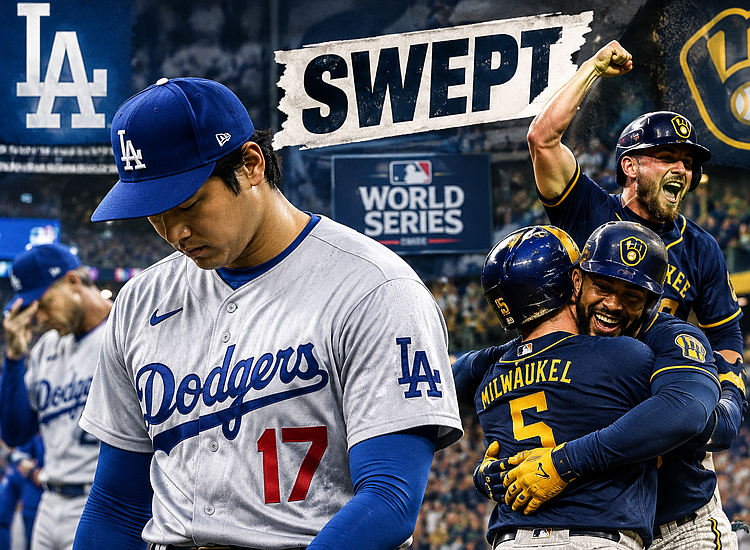
Dodgers’ Three-Peat Dream Crushed as Brewers Sweep NLCS
So, the Los Angeles Dodgers will not three-peat.
Swept by the Milwaukee Brewers in the National League Championship Series, the Dodgers’ season has ended early for the first time since 2023. They made themselves main characters of the sport by winning rings – and villains by spending billions. Or maybe it was the other way around. Either way, their success and their largess dominated the story of baseball this summer and, with a labor battle looming, it will again this winter.
Somebody else – the Brewers or Tampa Bay Rays or Cleveland Guardians – will win the World Series with a payroll that’s a fraction of LA’s. Cleveland hasn’t won in 78 years. Milwaukee and Tampa Bay have never won a ring.
Viscerally – and narratively, judging by the discourse – this is shocking. It is shocking because over a two-year span the Dodgers have started to seem inevitable. It is shocking even though history tells us that winning three World Series in a row is so difficult and unlikely that to expect it is utter folly.
We must say quickly that the Dodgers lost because the team they were facing was trying, too. This is uninteresting and always true. But it is a little more interesting and a little more true in this case because the Brewers are notably great. The Dodgers — those behemoths of payroll and destiny and a predetermined aura that, even if they don’t win it all, they’ll at least play the role of Final Boss, beaten only by a plucky upstart — lost to the team with the best regular-season record.
The Brewers won the most games in baseball this year. They won the most games last year, too, before the Dodgers swept them in the NLCS. They did not win the most games in baseball in 2024, but if you start in 2024, the Brewers have won the most games over the past three regular seasons combined.
The three seasons before that? From 2021, following their bubble World Series win at the end of the pandemic-shortened season, through 2023, the Dodgers won the most games in baseball.
That’s a lot of numbers and convoluted context to make a simple point: A best-of-seven series can only tell us so much about the Dodgers and especially about the sport’s economic landscape going forward.
To be more explicit, the owners, as represented by the league, will not retract their salary cap proposal simply because we are now guaranteed a low-payroll team will win the World Series. The Dodgers were a convenient boogeyman, but the owners’ desire for cost-control is not actually contingent on the results of a small-sample-size tournament.
But what did we learn about the venerated and ultimately fallible Dodgers?
Compared to the Brewers, they look older, which they are, and perhaps more complacent, which they probably are. They looked, at times, tired.
“The train finally ran out of steam, I guess,” Max Muncy, the team’s longest-tenured player, said after the final 6-4 loss.
Which, can you imagine anything else for a team that played an extra month of baseball the last two years and traveled the most miles those seasons after starting both 2024 and 2025 in Asia? It is, after all, a team composed primarily of dads in their mid-30s.
“They may have a bunch of Hall of Famers, but we have a bunch of gamers,” Brewers manager Pat Murphy said. “And the gamers won this week.”
It was an apt comparison and an insightful one for the way it painted the Dodgers’ living legends as a detriment, or at least as losers.
Tough decisions ahead
In the clinching game, Shohei Ohtani homered. It was a cathartic, euphoric moment for the global superstar, the greatest player of his generation.
But before that, he had gone two months without leaving the yard. All postseason, he appeared limited by an injury and largely ineffective at the plate. Dodgers manager Dave Roberts kept him in the lineup, moving him around the batting order and refusing to bench the biggest name in the sport. Who could be better, or at least more deserving of deference, than Shohei “four-time MVP” Ohtani?
It was a manifestation of the problem that will continue to plague the Dodgers at least into next season. The problem of: Too Many Future Hall of Famers.
For the fourth-straight season, the Dodgers’ position player group was the oldest in baseball. Initially, that was reflective of the fact that they are the most willing to pay the free-agency premium for proven talent. But the aging curve is undefeated, and eventually that looks like Mookie Betts and Freddie Freeman – both former MVPs who came to LA after winning titles elsewhere and then won together – going 4-for-29 (a .138 batting average) without an extra-base hit in the series.
But you can’t bench those guys, either. Even if their best days are behind them, they’re still better than most. Just not as good as they used to be. But that isn’t always good enough when the opponent is also elite.
Eventually, being the oldest team isn’t a sign of established greatness – it’s a sign the window could be closing.
In recent history, the Dodgers have been able to spend their way to continued contention, adding an influx of stars every offseason. The obvious candidate to do that this winter is Tarik Skubal, who ended the season in LA after the Dodgers traded for him at the deadline.
. The Dodgers’ front office has always been smart, in addition to being rich, and that’s the real secret sauce.
But this October has shown there are savvy contenders in small markets, too. And the Dodgers’ financial advantage might be fleeting.