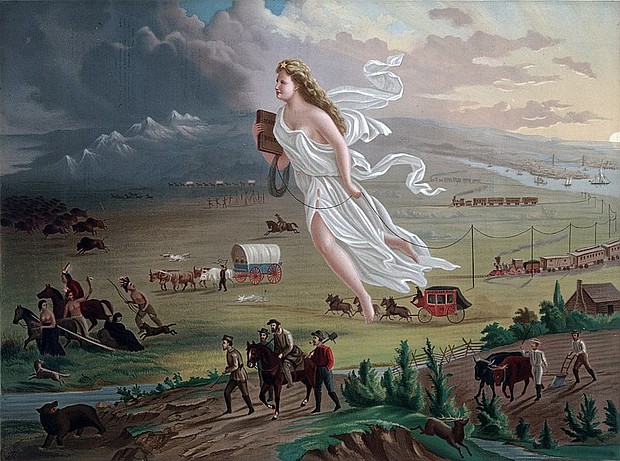
This painting shows "Manifest Destiny" (the belief that the United States should expand from the Atlantic to the Pacific Ocean. In 1872 artist John Gast painted a popular scene of people moving west that captured the view of Americans at the time. Called "Spirit of the Frontier" and widely distributed as an engraving portrayed settlers moving west, guided and protected by Columbia (who represents America and is dressed in a Roman toga to represent classical republicanism) and aided by technology (railways, telegraph), driving Native Americans and bison into obscurity. It is also important to note that Columbia is bringing the "light" as witnessed on the eastern side of the painting as she travels towards the "darkened" west.
Stories this photo appears in:
Manifest Destiny in Modern America
One weekend evening in 1966, while traveling from Camp LeJeune in Eastern North Carolina to Myrtle Beach, S.C., my Marine buddies and I began to see roadside signs advertising a “Fish Fry” near the South Carolina border. It was late, we had not eaten dinner, and fried fish sounded like a pretty good idea. We followed the signs that led down a dark country road to a point where cars were turning into an open field.